Building Systems That Solve Real Problems
I focus on backend engineering, scalable APIs, distributed systems, and data-intensive applications. Each project below is a full case study — architecture decisions, challenges solved, and lessons learned.
Cloud Storage Platform
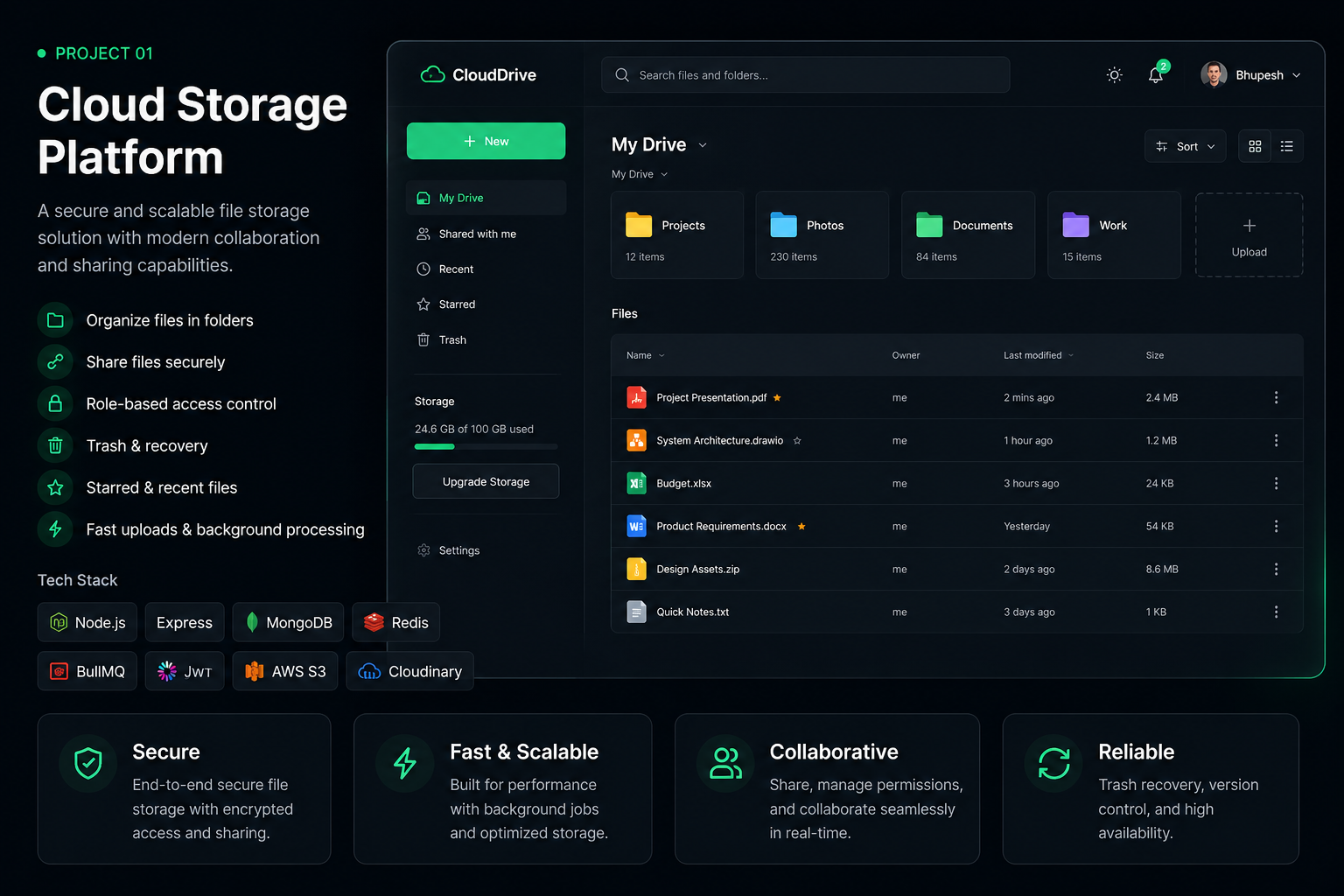
A Drive-style cloud storage product with folders, uploads, auth, sharing, and a polished file-management experience.
Cloud Storage Platform
A scalable cloud storage platform inspired by modern file management systems — designed to handle file uploads, directory structures, sharing, authentication, and storage management at scale. Built with a strong focus on security, performance, and maintainability.
The platform enables users to organize, share, and manage digital assets through a seamless web experience. The system was designed from the ground up to support a rich set of user-facing features while maintaining clean backend architecture, security best practices, and data integrity.
Unlike traditional storage solutions, this platform supports both personal and shared workspaces with fine-grained access control — enabling users to create public sharing links with configurable permissions while keeping private data fully isolated.
Security was treated as a first-class concern throughout development — not an afterthought. Every route, token, and data access path was evaluated for injection, traversal, and privilege escalation risks.
Multi-Provider Authentication
Secure login via Google OAuth, GitHub OAuth, and email OTP verification — all backed by JWT-based session management.
Hierarchical File System
Parent-child folder relationships with recursive traversal, mirroring a real OS file system at the database layer.
Access-Controlled Sharing
Generate secure, token-scoped public links for files or folders with configurable visibility and expiry.
Advanced Search & Filtering
Real-time search across file names, types, and metadata — powered by indexed MongoDB queries.
Trash & Recovery System
Soft-delete mechanism with a recoverable trash bin — ensuring no accidental permanent data loss.
Starred & Recent Tracking
User activity tracking for recently accessed and starred files — improving navigation efficiency.
One of the major challenges was designing a scalable file and folder hierarchy while maintaining fast retrieval and navigation. Below are the critical problems identified and the solutions implemented.
Scalable Hierarchical Data Model
Designed a parent-child MongoDB schema where each file and folder stores a reference to its parent ID. This allows O(1) lookups per level, and efficient recursive traversal for operations like folder size calculation or bulk deletion — without expensive recursive joins.
Secure Public File Sharing
Implemented token-based public sharing where each shareable link contains a signed, time-scoped token. Access to shared resources is isolated from private user sessions — even if a private file ID is guessed, it cannot be accessed without the valid share token.
NoSQL Injection & XSS Prevention
All user inputs are sanitized before reaching the MongoDB query layer. Mongoose schema validation combined with Zod boundary validation ensures no malformed operators can manipulate queries. Helmet.js and Content-Security-Policy headers protect against XSS vectors.
Performance-Optimized Queries
Strategic MongoDB indexing on parent IDs, user IDs, and file names reduces query time for folder listing from O(n) table scans to near-constant lookups. Lean queries strip Mongoose overhead for read-heavy operations.
The backend follows an API-first architecture with a clean separation between controllers, services, and data access layers. The authentication system is stateless — all session state lives inside signed JWTs — making horizontal scaling straightforward.
Some of the best products start with a simple conversation.
Whether you're building a scalable backend, a distributed system, or a data-driven application — I'd love to discuss your project and explore how I can help turn your ideas into reliable software.